Yemen at a Crossroads: Southern Control and the Road Ahead
- Bayan Peikari

- Dec 10
- 4 min read
Yemen has entered December 2025 amid one of the most consequential shifts in its political and military landscape since the civil war began in 2014. After years of parallel authorities, stalled negotiations, and intermittent conflict, the early days of the month brought rapid territorial changes driven by the Southern Transitional Council, rising political tension between rival factions, and renewed concern among regional actors. These developments unfolded against a backdrop of long-standing humanitarian strain and a fractured national governance structure.
A New Southern Offensive
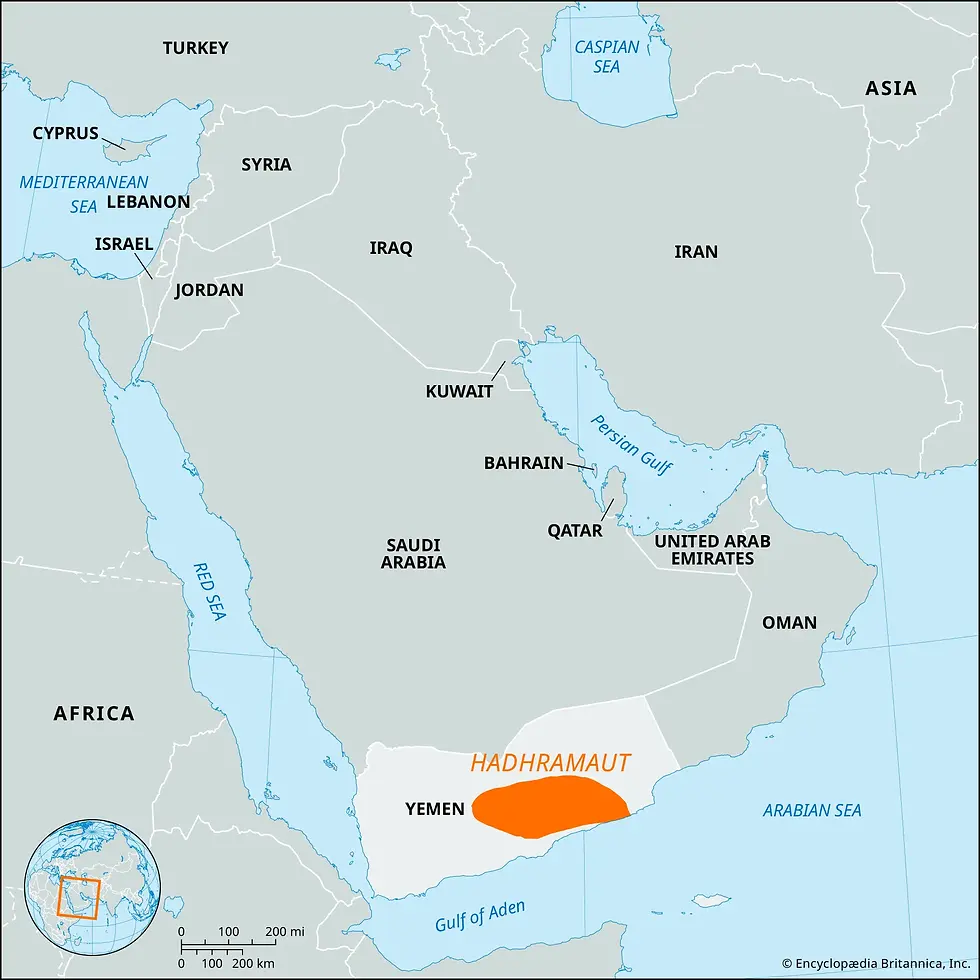
On December 2nd, the Southern Transitional Council, known as the STC, launched a major military campaign across Hadhramaut Governorate that it named Operation Promising Future. The offensive was planned over several weeks, according to regional analysts, and aimed at dismantling government aligned security networks and asserting direct STC control over key areas of the south. The Hadhramaut valley was chosen as the central focus because it contains major population centers, energy infrastructure, and important logistical corridors that connect the region to the rest of Yemen.
By December 3rd, STC forces had captured Seiyun, one of the most politically symbolic cities in the governorate, along with a number of military bases that had been used by units affiliated with the internationally recognized government. The rapid capture of these sites indicated not only strong coordination within the STC but also weaknesses in the government’s command structure in the region. Local sources reported that several units withdrew without significant resistance, reflecting both logistical challenges and declining morale.
The STC defended the operation as a response to what it described as rising lawlessness, extremist activity, and smuggling networks in the south. Its leadership argued that government forces failed to provide basic security and that the takeover would create conditions for more stable governance. However, the speed and scale of the offensive surprised many observers and signaled that the STC was prepared to reshape the political map of southern Yemen in a more permanent way.
Control Across the Former South Yemen
By December 8th, the STC announced that it had consolidated authority over all eight governorates that once made up the former state of South Yemen prior to unification in 1990. This included the symbolic and strategic city of Aden, which has functioned as the operational base of the internationally recognized government since the outbreak of Yemen’s conflict. The STC’s announcement effectively marked the first time since the early 1990s that one faction held undisputed control over the entire southern region.
The takeover carries major political consequences because southern Yemen contains vital infrastructure that underpins the country’s economy. The coastline along the Gulf of Aden and the Arabian Sea includes ports used for commercial trade, fuel imports, and humanitarian deliveries. Hadhramaut, in particular, is home to some of Yemen’s most productive oil fields and export terminals. Control of these sites provides the STC with both revenue potential and strategic leverage as negotiations over Yemen’s future continue.
The consolidation also affects internal southern politics. The STC has long claimed to represent the aspirations of southern Yemenis seeking greater autonomy or full independence. With territorial control now unified under a single authority, the group is better positioned to advance its political program, whether through negotiations or through unilateral action. However, some local communities in Hadhramaut and Al Mahrah have historically resisted centralized control, even from southern entities, which may complicate the STC’s efforts to govern effectively in the long term.
Government Pushback and Rising Political Strain
The internationally recognized government responded sharply to the STC’s advance. The Presidential Leadership Council, led by Rashad al Alimi, stated that the STC’s actions violated the power sharing framework created after the 2022 realignment of anti Houthi forces. The council argued that the offensive jeopardized national unity and undermined the possibility of a comprehensive political settlement. Government officials also accused the STC of pursuing a unilateral agenda that prioritized territorial expansion over the collective effort to stabilize the country.
The government’s capacity to respond militarily was limited, however, due to fragmented command structures and reduced territorial control. Many of its units are dispersed across central and eastern Yemen, while others remain engaged along frontlines with the Houthi movement in the north. These constraints weakened the government’s negotiating position and raised doubts about its ability to reassert authority in the south without external assistance.
The developments intensified political tension throughout Yemen. The Houthis, who control much of the north, benefited indirectly from the divisions within the anti Houthi camp. The weakening of the government’s position in the south altered the balance of power and complicated ongoing discussions about future political arrangements. International observers expressed concern that Yemen was drifting further from a unified framework for peace and closer to a long term territorial fragmentation that could mirror the country’s pre 1990 configuration.
Strategic Implications and Uncertain Paths Ahead
The STC’s expanded territorial control gives the group significant leverage in shaping Yemen’s future political landscape. Control of port facilities, oil producing regions, and southern transportation corridors enhances its economic and strategic position. These assets may allow the STC to negotiate with both regional powers and international actors from a position of greater confidence. They also increase the likelihood that any future political arrangement will need to account for a distinct southern authority with formal or informal autonomy.
Despite these gains, many questions remain unresolved. The STC has not formally declared independence, although its actions have created conditions similar to those of a separate state. Any move toward independence would require navigating complex regional dynamics, including the positions of neighboring states and international organizations that currently recognize a unified Yemen. Additionally, some southern communities may resist centralized STC governance, which could produce new local tensions even within the south.
The humanitarian implications are also uncertain. Shifts in territorial control often affect the distribution of aid, the operation of local services, and the movement of civilians. While the STC has pledged to improve security and governance, it will need administrative capacity and financial resources to do so effectively. The coming months will reveal whether the group can translate military gains into stable administrative structures or whether Yemen will enter another period of fragmentation and instability.
Sources:
Critical Threats Project. 2025. “Iran Update December 9 2025.” December 9. link
FDD Long War Journal. 2025. “Southern Transitional Council Seizes Key Areas of Yemen’s Hadramawt Governorate from Rival Government Forces.” December 4. link
The Defense Post. 2025. “Yemen Separatists Make Major Territorial Gains.” December 9. link
The Soufan Center. 2025. “IntelBrief December 8 2025.” December 8. link


